Check the delivery scope first, not just the total price
When many companies sign a website development contract, they look at the price first. But what usually determines whether the project runs smoothly is not the quote number itself. It is whether the contract clearly defines the delivery scope.
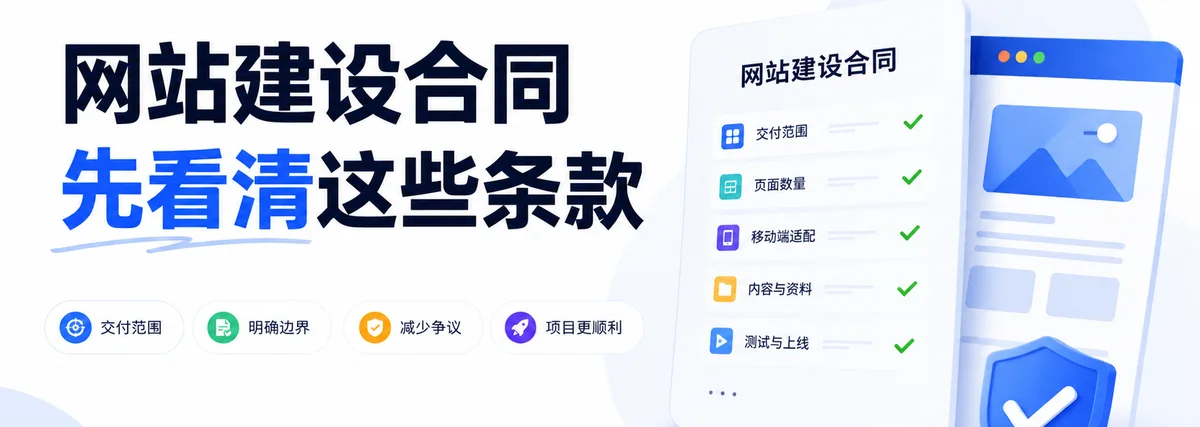
For example, how many homepage and inner-page designs will be delivered, whether mobile adaptation is included, how much content entry is covered, who organizes images and case materials, and whether basic launch testing is included should all be written clearly. If not, execution-stage misunderstandings are very likely.
For a company, the core value of a contract is not simply to confirm cooperation. It is to lock in both sides' understanding of the project boundaries. The clearer the scope, the more stable the work will be and the less likely the project is to get stuck in repeated disputes over details.
Revision rounds and feedback methods should be agreed in advance
One of the most common disputes in website projects is that the two sides understand "revision" differently. The company may feel that pages should continue to be adjusted until they meet expectations, while the service provider may feel the requested changes already exceed the original scope. If this is not clarified in the contract, it will almost certainly become a problem later.
A safer approach is to break the process into key checkpoints: how many rounds for structure confirmation, how many rounds for homepage design, how many rounds for inner-page extension, and how many rounds for pre-launch testing. This helps the company understand when feedback should be given and reduces the risk of major rework late in the project.
The feedback method also matters. Will feedback be collected in one batch or confirmed screen by screen? Will it be summarized in a document or added as online annotations? Is there a time limit for each feedback round? These details directly affect project efficiency. Many projects are delayed not because the design is difficult, but because the feedback mechanism is unclear.
Content ownership, source files, and launch support must be clear
After a corporate website goes live, companies usually need to add cases, publish articles, and update product information. That is why ownership of content and deliverables should be confirmed early. Design files, frontend pages, backend accounts, image assets, entered articles, and case materials should be clearly listed as either delivered assets or limited-use items.
Source code and backend access are especially important. If the company plans to maintain the website over the long term, it should not wait until launch to ask whether handover is possible. A mature project should clarify at the contract stage who provides the hosting environment, who manages the domain and server, whether future migration is supported, and whether the company can handle content maintenance itself.
Launch support is just as important. Some contracts only mention page production, but do not include deployment coordination, browser compatibility checks, form testing, link verification, or support for fixing launch issues. In that case, the pages may look finished while the project is not actually ready to go live.
Clear maintenance boundaries prevent the project from breaking after launch
Many companies assume small post-launch changes are included in the original project. Service providers, however, often treat them as new maintenance work unless the contract says otherwise. This is one of the easiest places for disagreement to appear.
Before signing, it is better to confirm the post-launch support period, the scope of issue fixes, whether content updates are billed separately, and how additional pages will be priced. This does not make the project unnecessarily complicated. It prevents the cooperation from entering an unclear gray area as soon as the website goes live.
A contract that truly protects a company is not necessarily the longest one. It is the one with specific key terms. When delivery scope, revision mechanisms, launch support, and maintenance boundaries are clear, the website project moves according to defined rules rather than relying on mutual assumptions.