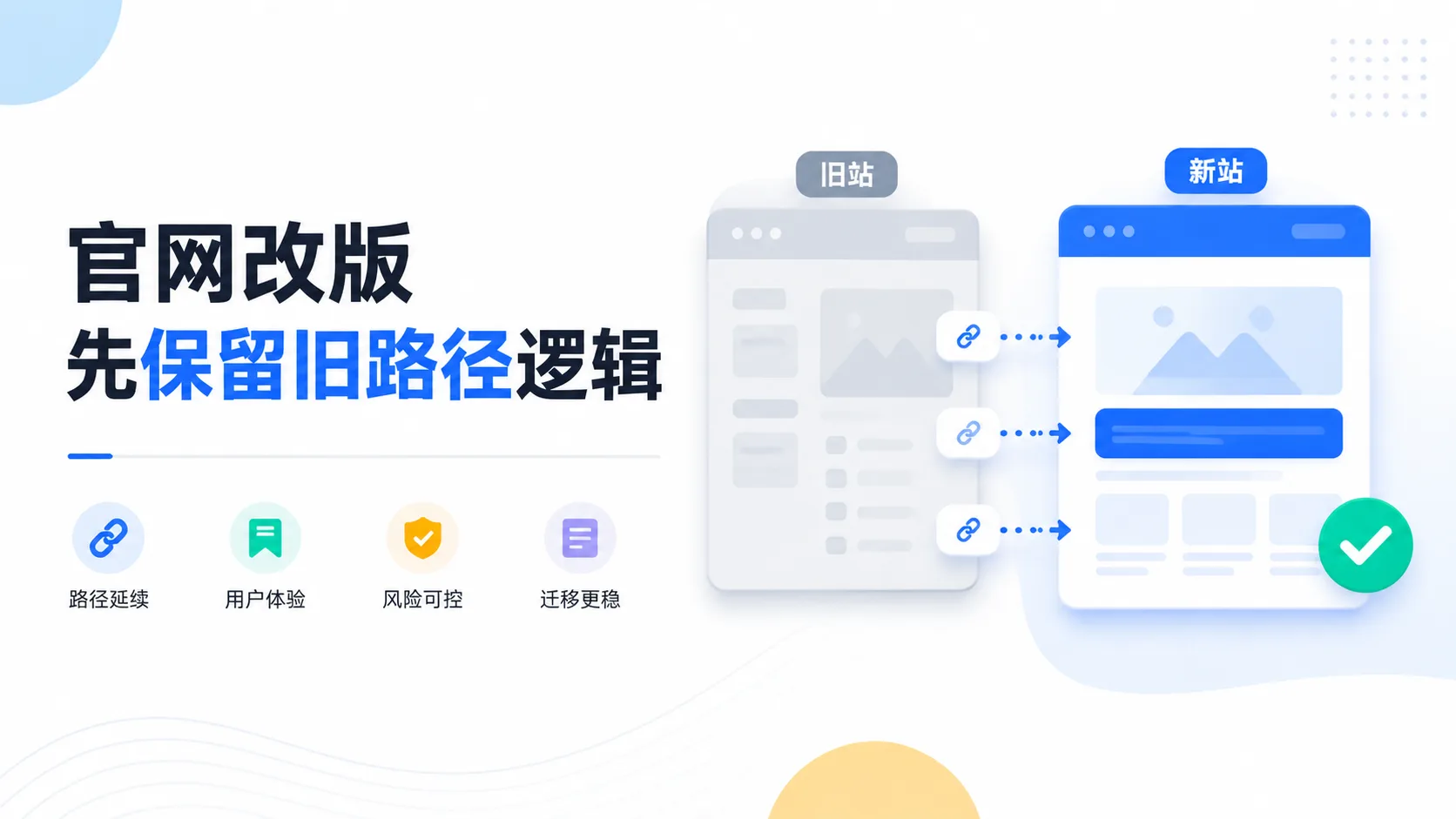
A redesign is not only about new pages, but also content continuity
When companies redesign their websites, they usually focus on visuals, structure, and content reorganization. In implementation, however, one easily overlooked issue is how to handle the relationship between existing page URLs and the new site.
If this issue is not considered in advance, the website may still go live, but a series of problems can follow: old links cannot be opened, customer bookmarks become invalid, historical article addresses all change, and internal references across the site break.
Keep the old path logic first, migration will be more stable
Preserving old URL logic first does not mean copying the old site structure exactly. It means identifying which old pages still have ongoing value early in the redesign, then keeping a clear relationship between those pages and the new site.
For example, high-value case pages, frequently cited article pages, product catalog pages, and contact pages are usually worth keeping stable, or at least worth mapping to redirects in advance. The benefit is practical: when the new site goes live, the original access paths are not suddenly interrupted by a large number of URL changes.
For companies, this stability is not only a technical matter. It also affects customer experience. If a page that previously opened suddenly fails after a redesign, the website's overall credibility is weakened.
Path retention essentially reduces revision costs
Many companies think URL paths are a small issue, but once they discover after launch that old articles, old cases, and old product pages all need to be processed again, they realize it is a large hidden workload. For content-heavy sites in particular, completely resetting URL logic can mean checking every page type separately later.
By contrast, if core URL rules are preserved early, or mapping is built around the old site's logic, the cleanup cost after launch is much lower. The service provider can test the launch more easily, and the company can more clearly judge which content migrated smoothly and which content needs further optimization.
This is also common in mature redesign projects: the structure can be upgraded and pages can be rebuilt, but the important relationships from the old site should be preserved first and optimized gradually later, instead of being overturned all at once.
A good redesign is an upgrade, not a break
The goal of a website redesign should be clearer expression and easier maintenance, not a sudden disconnection from previous content assets. The more stable the URL logic remains, the more the redesign feels like an upgrade. If every path is discarded and rebuilt, the redesign becomes more like a break and reconstruction.
The reason to preserve old URL logic first is straightforward: it makes migration smoother, keeps content relationships more continuous, and reduces cleanup work after launch. For a company, this kind of redesign is better suited to long-term use than one that only looks fresh on launch day.