
GridOS Is Not One Website, but a Maintainable Website System
Many companies do not simply need another website
When a company prepares to redesign its official website or add a new site, the visible requirement often sounds simple: build a website. But during real project delivery, the harder questions are usually about content and maintenance. How should existing content be organized? How should different language versions be maintained? Where should contact information be updated? How should historical content be preserved? Who will keep the site updated after launch?
This is why many websites fall into a new kind of disorder soon after the first version goes online. There is no unified entrance for content updates, site configuration is scattered, language versions are maintained separately, contact information has to be changed in several places, and old content is difficult to clean up. The website has technically been delivered, but the long-term maintenance cost keeps rising.
GridOS is built for this type of problem. It is not only about producing a website. It is about turning the website into a system that can be maintained continuously.
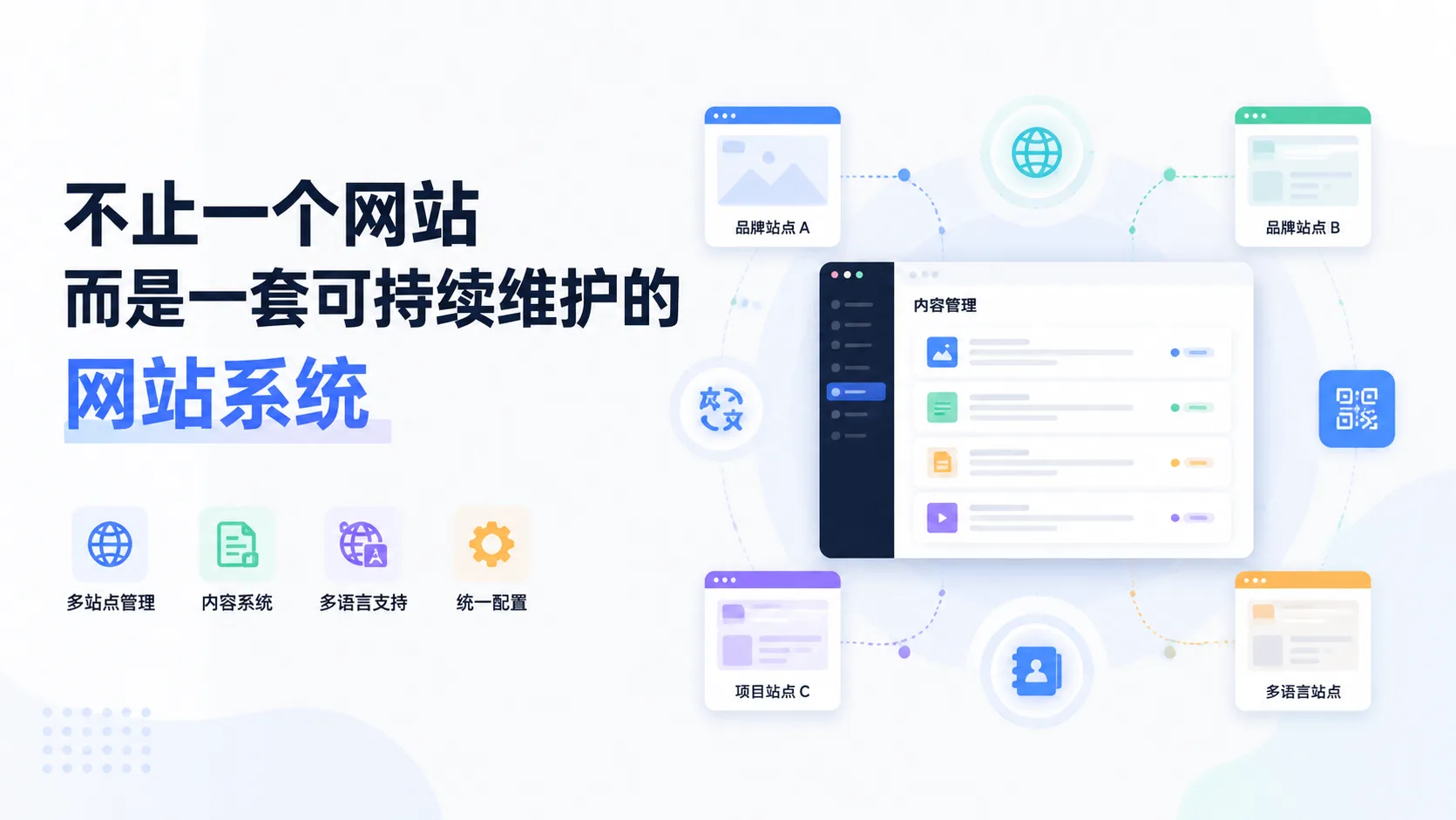
A single page can present information, but a system is needed for long-term maintenance
If we only look at the first delivery stage, a website can be quickly assembled through design and frontend implementation. But the real life cycle of a corporate website starts after launch. Products, cases, updates, contact information, image materials, and language versions will continue to change as long as the business keeps operating.
This is where a page alone is not enough. A page can display information, but it does not naturally solve the order of future maintenance. If the underlying structure is not clear, every update depends more on memory and temporary changes. At first, the team changes one item. Later, it needs to change many related items. At first, it adds one page. Later, it discovers that the whole structure is not clear enough.
GridOS adds another layer of work: not only making the page look right today, but also considering how later changes will happen. Content, configuration, and maintenance paths can gradually return to a more orderly system.
GridOS focuses on the unity of content, configuration, and structure
In long-term website operation, the content types most likely to become difficult to control are usually quite typical: site information, contact lists, QR code content, multilingual copy, section structures, content paths, and small configuration items that change often. Each item is simple by itself, but when all of them are scattered for a long time, maintenance becomes increasingly expensive.
The value of GridOS is to gradually unify these common parts. Different sites do not need to look the same, but they should share a clearer underlying logic for maintenance. Then adding pages, updating content, adjusting navigation, synchronizing languages, or changing contact information can all return to a stable data entry and update process.
This is why GridOS should be understood as a website system rather than a page template. A template mainly answers how something is displayed. A system is more concerned with how it will continue to be maintained.
For multi-site scenarios, systemization matters more than one-time delivery
This becomes even clearer for companies with multiple brand sites, project sites, or language versions. The more sites there are, the more small problems get amplified. If contact information is updated in Chinese, has the English version also been updated? If a QR code changes on one brand site, is another site still using the old one? If a section structure changes, are the new and old page paths still clear?
If each site follows its own maintenance habits, it may work in the short term. Over time, however, consistency and efficiency both decline. GridOS is better suited to situations where multiple sites, multiple versions, and multiple content sources exist at the same time. It does not make all sites look identical. It helps prevent them from becoming increasingly disordered during long-term use.
From this perspective, GridOS is not simply placing multiple websites side by side. It is gradually bringing them back into a more manageable system.
The value appears not only at launch, but in every later update
After a first version goes online, many companies do not suffer from having no website. They suffer from having a website that becomes harder and harder to maintain. If every update requires finding developers, designers, and historical files, the site cannot easily become a stable business asset. It remains closer to a one-time deliverable than a system that grows with the business.
GridOS tries to move this state forward. It is not only concerned with whether a page looks polished today. It is concerned with whether the site can keep advancing when content is added, configuration changes, languages are expanded, cases are added, and materials are replaced.
For companies, this value is often not fully visible on launch day. It becomes clearer through every later update. Whenever new content, new structures, or new versions are needed, the benefits of systemization become more obvious.
More valuable websites are usually not completed all at once
A mature corporate website is rarely finished in one delivery. It grows through long-term maintenance: content is added, structure is adjusted, old information is cleaned up, expression becomes more unified, and the site evolves with the business.
GridOS therefore does not treat a website as a one-time project that ends after launch. It places the site inside a system that can continue to be organized, updated, and improved. In this way, a site has a better chance of moving from usable to maintainable, and then toward a real long-term business asset.
This is why GridOS is not one website. It is a maintainable website system. Its focus is not only whether a site launches today, but whether it can still be used stably and maintained clearly next year and the year after.